
Was Epicurus Actually the First Existentialist?
Sending Soren Kierkegaard into an existential crisis

Philosopher, cult leader, Ancient Greek, Athenian, Ataraxic, Not the same as Epictetus, Atomist: Epicurus is a man with many labels and titles, yet a shocking limited amount of surviving writings.
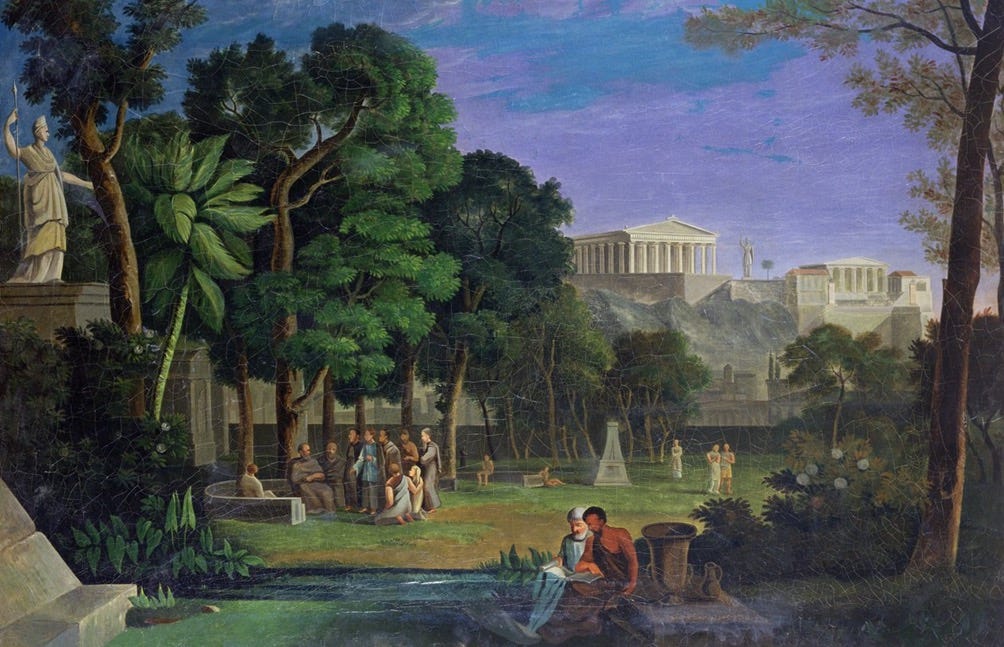
Epicurus, beyond or maybe tangential to his main philosophies, held beliefs relating to atomism and materialism that have since been proven to be kind of wacky but, if you were placed in Ancient Greece, they would have been pretty rational lines of thinking1.
What Epicurus wrote most about, however, were the ideas of happiness, pleasure, and mental clarity or peace, a.k.a ataraxia (ἀταραξία)2.
While influenced by Aristotle and his ‘eudaimonic’ teachings and branches of teachings, Epicurus often opted for a more digestible goal in happiness called ‘ataraxia.’ Epicurus’ problem with eudaimonia is that, despite being the long-lasting accomplishment of human flourishing through virtues, it was scaffolded towards the end of one’s life.
Eudaimonia as a state is restricted in its appearance to a person. It is the culmination of a virtuous and contemplative life. This leads one to the question as to how one can know whether they are on the virtuous path to eudaimonia, to a flourishing life, or, more importantly, whether they are not on a eudaimonic path which would need to be corrected for optimal happiness and contentment with life.
Epicurus’ “solution” to this question or - better said - highlighting of individual paths to eudaimonia was ‘ataraxia.’ Eudaimonia is inherently individualized. While all of the virtues are important to be lived and important to practice, a firefighter may opt to practice the virtue of courage more than the virtue of obedience for example. In their line in life, it’s more important for a firefighter to be courageous and willing to run into fires than it is for them to listen when someone asks them not to cut in line for the bathroom.
The kinds of virtues sought out and their order of importance (or necessity of practice) vary between people. Think of eudaimonia as a number (let’s say 100 for now). There are many ways to get to 100: 10x10, 99+1, 2010-1910, √10,000, etc. There are many ways of getting to eudaimonia and every life is a formula to solve.
A teacher may need to practice creativity as a virtue in altering lessons to best reach their unique students. But, assertiveness may not be so necessary on a daily basis. While a good virtue for a teacher to have - perhaps in standing up for themself - assertiveness may not be beneficial when asserting a religious belief that evolution doesn’t exist when Charles Darwin is being taught.
Ataraxia can be visualized as a eudaimonic calendar. It is a daily advance towards a cumulative eudaimonia. Ataraxia is better translated into English not as ‘human flourishing’ but unperturbedness, equanimity, and tranquility as a lucid state removed from distress and worry/anxiety.
Epicurus was putting these ideas together, relating happiness with an avoidance of anxiety over 2,000 years before Kierkegaard purportedly kickstarted the school of existentialism. And what is finding the meaning in life but essentially or basically discovering one’s anxieties to avoid and one’s happiness to ascertain?

With the author listed as ‘Vigilius Haufniensis,’ ‘The Concept of Anxiety’ was written by Kierkegaard and published in 1844, 2,114 years after Epicurus died in 270 BC.
In ‘The Concept of Anxiety,’ Kierkegaard is able to describe anxiety as being the “dizziness of freedom.” This starts to make a lot of sense the more one considers it. Kierkegaard, also in ‘The Concept of Anxiety,’ later demonstrates a connection between anxiety and sin. A devout Christian, Kierkegaard noted how anxiety about sin produces sin. This is a concept that is going to be familiar to any athletes out there or any Tourette’s sufferers among us.
Standing over a ball, a golfer thinks to himself “whatever you do, just don’t hit this left into the pond.” Guess where that ball is going to go. And yes, I’m calling golfers athletes.
Coprolalia is a phenomenon in tics surfacing from Tourette’s syndrome where the speaker says the exact thing they should not say. A good example of this is John Davidson sitting in the audience of the BAFTAs, knowing there’s one word he should not say with Delroy Lindo and Michael B. Jordan presenting the first award, and proceeding to yell the ‘n-word’ at the two black men.
These kinds of anxieties are the ones that Epicurus is advising people against; he simply did not possess a word for anxiety in the same way we do in English and Kierkegaard did in Danish. Again, this is a unique challenge to each person. I do not have Tourette’s syndrome so it is not terribly difficult for me to not yell the n-word at Michael B. Jordan. As such, Epicurus and even Kierkegaard cannot broadly state that the anxiety within Tourette’s such as this needs to be as devoutly abided by every person.
I do, meanwhile, have extraordinary anxieties surrounding conflict. I would not be a confrontational person and would prefer, if nearing an argument, to just agree with whoever I am speaking with. Others may say this is detrimental, inauthentic, or hypocritical and I can’t very well argue against those claims. I also won’t start the argument in any sort of petty defense. That matters not to Epicurus here as his advice would be for me to avoid anger and combativeness; to avoid the antecedents of these anxieties in order to remain, as if on a spectrum, near to satisfying pleasure than anxious discomfort.
Five years after writing about the concept of anxiety, Kierkegaard deepened our understandings of human/emotional depth with his exploration in ‘The Sickness Unto Death’ and that gives me an excuse to again share my favorite beginning to any philosophy book I have read. Part One Chapter A of ‘The Sickness Unto Death,’ in English, reads:
“A human being is a spirit. But what is spirit? Spirit is the self. But what is the self? The self is a relation that relates itself to itself or is the relation’s relating itself to itself in the relation; the self is not the relation but is the relation’s relating itself to itself. A human being is a synthesis of the infinite and the finite, of the temporal and the eternal, of freedom and necessity, in short, a synthesis. A synthesis is a relation between two. Considered in this way, a human being is still not a self.” - Anti-Climacus (1849; Kierkegaard’s pseudonym3 for this book).
Despair, as Kierkegaard describes it, is not simply sadness or pessimism. It is a state when one has the wrong conception of themself. Kierkegaard lists several states of despair in ‘The Sickness Unto Death:’
1. Ignorance of the potential of the self
2. Desire to not be oneself, the desire to not be a self, and the desire to be a new self
3. Demonic despair; despair of defiance - the self attempts to alleviate its despair and finds no help, thus severing their relationship to God and angels [Note: again, Kierkegaard was very religiously Christian].
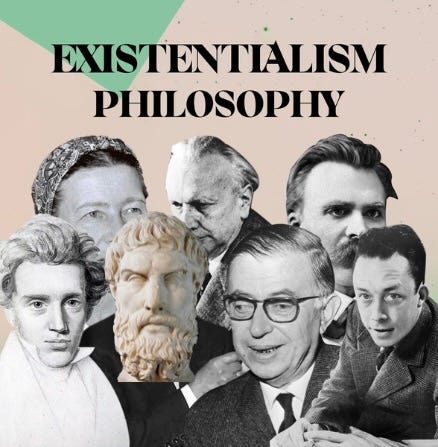
Later philosophers such as Albert Camus, Jean-Paul Sartre, Simone de Beauvoir, Franz Kafka, Martin Heidegger, Hannah Arendt, and so on have gained a lot of insight from Kierkegaard’s works surrounding anxiety and despair. These writers would go on to create more foundational existentialist and absurdist schools of thought such as exploring topics on suicide, being, nothingness, time, the plight of women, ‘nausea4,’ and the comic ugliness available and possible with life’s freedom(s).
What these men and women attempt to enhance our world’s understandings of, as a whole, is how life’s meaning is conjured and conjugated, how it is unique, and - without inciting eudaimonia specifically - how there is a state to strive towards which can be assumed every day and practiced.
Whether it’s Camus’ ‘The Stranger’ considering the meaning of trouble and punishment, de Beauvoir’s dives into the equality of women with ‘The Second Sex’, or Heidegger’s descriptions into whether or not ‘nothing’ is even a possibility in ‘Being and Time’, we can quite clearly see that there are attempts being made to extend beyond Kierkegaard’s foundational anxieties and despairs and there are existentialist attempts and experiments to more fully describe why happiness is not static, why flourishing may not be found everyday and that that does not mean it abandons one’s self, and why the capabilities of humans (or humanity) cannot be overestimated.
So what does this have to do with Epicurus?
To abruptly compare Epicurus with Kierkegaard and the other existentialists we can take a peek at Epicurus’ “Four-Part Cure.”
‘Tetrapharmakos’ was the Greek word used by Epicureans as ways to generally and effectively avoid existential dread and anxiety: just the same as Kierkegaard sought. The four parts are:
1. Don’t fear God
2. Don’t worry about death
3. What is good is easy to get
4. What is terrible is easy to avoid
In short: if God is all good (and loving), then He will not evilly attack or disintegrate one person in any particular. In death, Epicurus did not necessarily believe in an afterlife. As a pretense to Pascal’s Wager, Epicurus notes that while alive you will not experience death and while dead, you won’t experience anything as death is the cessation of existence, i.e experience. There’s no need to fear death because you will not feel it.
Now, as a precursor to Maslow’s Hierarchy, Epicurus tells us what is good is easy to get and what is terrible is easy to avoid. This works in both complexity and in results. The “good” things that Epicurus leans towards are basic needs that Maslow will later order: shelter or protection from the elements, food supply, clothing, friends, and such. The “terrible” things that Epicurus alludes to are things such as anxiety and disappointment.
This would be a popular example of these final two parts of the cure in action: let us say you are preparing dinner; maybe it’s for an anniversary or to celebrate a promotion. It would be natural to want to do something special. Perhaps that something special is splurging a bit and getting nice cuts of steak at the grocery store. This would not really be advisable to Epicurus. While, yes, there is a chance that the seasoning is absorbed perfectly by the meat, the grill or stove cook through the steak excellently, and it is the best cut of dinner that you’ve had in ages.
But, the complications added to the process - reliance on the stove or grill brings in the chance that it ends up undercooked or burnt, it costs more which means more intention needs to be placed into its care, the seasoning may be uneven with parts of the steak being flavorless and other parts being too deeply soaked - are enough to be wary of it as a whole. If it makes better sense for you, we can say that there is an 80% chance that the steak comes out well and good; also meaning there’s a 20% chance it shits the pan.
If we take another offering for dinner - such as buttered bread, fresh picked apples, and some slices of cheese - that is much simpler than hoping for a steak to come out well, then there is a higher chance of enjoying the meal. The bread, apples, and cheese may not be as decorative and elegant as a steak, but there’s almost a 0% chance it goes wrong. There is a chance, so let’s say it’s a 99% chance of going well and a 1% chance that you eat too many apple seeds and die of cyanide poisoning.
Epicurus would recommend the latter meal as it will almost definitely avoid anxiety and deliver happiness.
Epicurus’ philosophy expanded
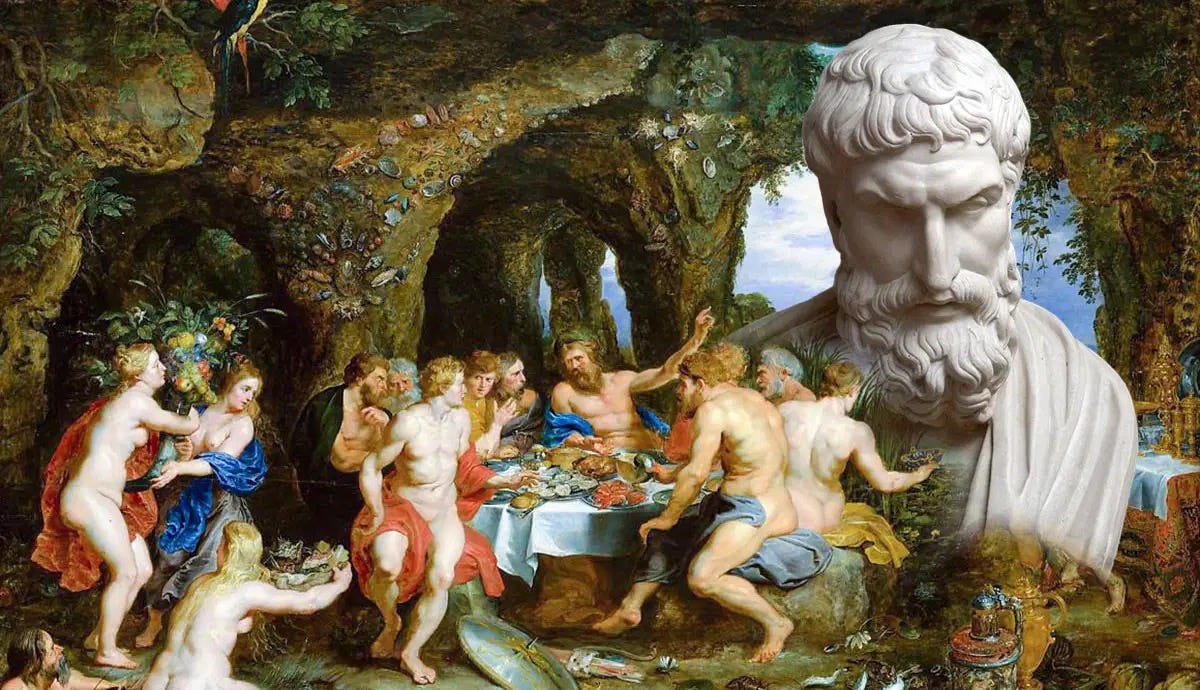
The desires requiring fulfillment can come in three versions to Epicurus: natural and necessary, natural but not necessary, and unnatural and unnecessary.
It is natural and necessary to have access to water. It is natural but not necessary to have sex. It is unnatural and unnecessary to desire power and/or greediness.
Friendships, collaboration, communal belonging, meaning from emotions, and the avoidance of displeasure (also phrased as the strive for successful pleasure) are tenets of Epicurean philosophy and they just so happen to be common or great examples of meanings in life - the desire of existentialism.
While Soren Kierkegaard and the succeeding existentialists are labeled so due to their emphasis on what anxiety and despair are, whether there are meanings to life and the recipes or instructions to discover and ascertain them, and the acceptance of the absurdity in life that can always surface and wrench plans, Epicurus preceded them with notions of happiness in its basic sense(s) and in seeking ataraxia or mental clarity and peace.
These seem to be the same goals with similar instructions but rewritten in Ancient Greek, Danish, French, German, and other (mostly) European languages.
It is not unique to Epicureanism or existentialism that happiness is the goal or even that life has meaning -or- even that anxieties should be avoided. Stoicism, metaphysics, epistemology, and aestheticism all enjoy the same eventual attempts at happiness, fulfillment, and clarity as are found in Epicurus’ writings and the writings of existentialists.
However, the hairs being split between Epicureanism and existentialism seem to be that Epicureanism had been long named before Kierkegaard (whether the name gained popularity in Ancient Greece or from the Renaissance and Pierre Gassendi’s resurrection of his works) and Kierkegaard simply did not attach himself to Epicurus. (This would be somewhat similar to Camus refusing the title of ‘existentialist’ during his lifetime and preferring a label of ‘absurdist’ when absurdism is a form of existentialism. That would be like shunning the label of American in favor of being known as a Masshole when a Masshole is an American).
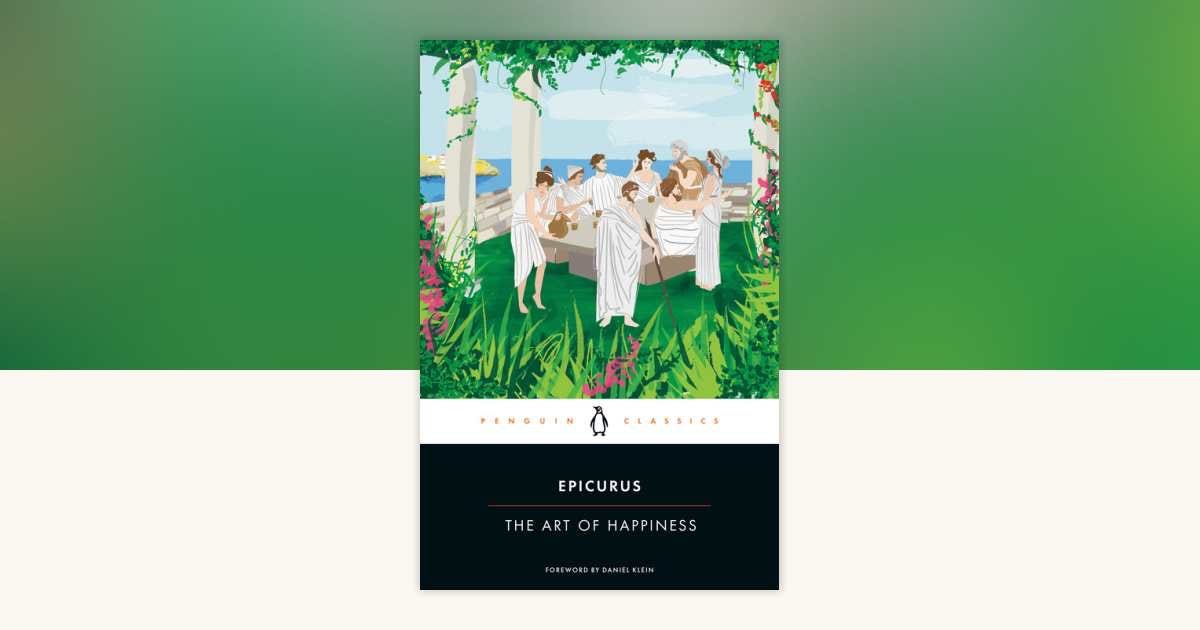
Epicurus, with the Penguin Classics version of his writings being titled ‘The Art of Happiness’ as evidence, is most commonly associated with the notion of happiness for which he uses the term ataraxia in relation to eudaimonic thinkings. Existentialism is what - a philosophy for finding a meaning for life, right?
Would anyone in their reasonable mind say that sadness is their goal in life? Sure, stubborn people exist and a lot of them are insistent on being upset or able to complain at all times. However, could this be more related to a cherophobic form of self-sabotage? I would say that explanation is more reasonable than to say that existentialism is too innocent.
Aristotle’s exemplified explanation of eudaimonia or happiness being the end goal of end goals can be modified to any life and could be written as such:
Why do you write on Substack?
I enjoy writing and the practice of it.
Why do you practice writing?
Because I want a job in writing and need to show my worth to employers.
Why do you need to show your worth?
So the employer knows that I am good at this and can be beneficial to their team.
Why do you need the employer to want you?
So I can get the job.
Why do you want a job?
So that I can have access to reliable money.
Why do you want reliable money?
So I can pay my bills and maybe even splurge on a steak every now and then.
Why do you want to pay bills and splurge?
So that I don’t have to worry about missing payments and becoming homeless?
Why do you want to avoid these worries?
So that it is easy to be happy?
Why do you want to be happy?”
Because…I like to be happy.
Why do you like to be happy?
Because it feels good being happy.
Why does it feel good being happy?
Because happiness is good.
Why is happiness good?
Because happiness is good.
Happiness, in Aristotle’s foundations, solidified by eudaimonic ideals, further broken down to ataraxic aspirations, and finally sought as a meaning for this life, is the eventual goal for any life where happiness is not simply a fleeting emotion but a rooted personal quality.
This does not mean that every philosophy ending in happiness is Aristotelian, Epicurean, or existential. The Garden of Athens [Epicurus’ school and community] is a basis for existentialism because of its embrace of anxiety’s many forms of existence and how pleasure is not only sought but is also equated to the cessation of dread and despair. These are the exact qualities of existentialism as purportedly founded by Soren Kierkegaard in the mid-1800’s, over 2,000 years after Epicurus.
Individual freedom, phenomenology, choice, authenticity, and responsibility - these are central tenets to existentialism. Would it be then correct to say that Epicurus’ philosophies greatly agree with the existentialist world view? I think so.
Conclusion
Epicurus continues to make himself known to me in strange ways; whether that be podcasts, recommended books, other Substack references, and so on, Epicurus continues to return to the forefront of discussions.
Perhaps this is due to a world being starved of happiness, of doom and gloom making itself the pervasive standard of essence, of pessimism being synonymous with default. In a world that is determined to make one feel powerless or without meaning, Epicurus’ writings are an excellent resource for re-learning one’s proper place in being welcomed to the world, for re-learning the value in life beyond the horrors that pop culture and news have sold their souls to.
I have previously declared myself an existentialist and I remain steadfast in this matriculation. The resurgence of Epicurus, at least on my timeline, has not deviated my existentialism, but I very much relate to a lot of references regarding happiness, ataraxia, and aporia (avoiding physical pain). Personal peace and clarity is the first step into a eudaimonic meaning in life.
The existentialist can very well find themself in Epicureanism, leading to my conclusion that Epicurus is the grandfather of existentialism, the father of Kierkegaard who is the father of existentialism.
I didn’t want to bog down the search into Epicurus’ existentialism with these diversions, so below are short explanations of Epicurus’ minor philosophical theories into atomism and materialism (which is not to be confused with being materialistic in a hoarding sense).
With atomism, he was correct in thinking matter is neither created nor destroyed. He would then continue to describe the motion of atoms, highlighting a sort of “swerve” between them. The “swerve,” as atoms in Epicurus’ theory were always moving downward unless inhibited by other atoms in collisions, was a seemingly innate concept in atoms to be able to randomly act out of accordance with what could now be described as gravity. This swerve of his was an explanation for the free will of humans - this ability in matter to deviate from the general pull of physics and to act with separate reasoning.
On top of that, with materialism, it was Epicurus’ belief that sense perception is the foundation of knowledge; that reason depends on the senses. Knowledge, presumably, could be found via reason without physical experience, but reason to Epicurus was a simulation of assumed sense perception, hence rending sense perception as the ultimate foundation.
My next tattoo will be of this on my wrist.
Kierkegaard published almost everything he wrote under pseudonyms. He did this for a few reasons, the two main ones being he was anxious that he would be outcasted if his name was attached to writing that ended up resonating and because, if the writing was really good, he wanted the ideas to stand for themselves. He wanted people to resonate with and enjoy his books because they feel so about the ideas, not simply because it was written by Kierkegaard and had his name on the front. For instance, if we took - let’s say - ‘Hamlet’ and put the name Princess Conseula Bananahammock on the cover, would it be just as history-defying as it is today, or is it only so revered because we revere the name Shakespeare? This is what Kierkegaard hoped to avoid.
Not an upset stomach but Sartre’s name for the horrific feeling that existence is meaningless.